By Ahmad Abu Omar
Translation: Lale Alatli
I am Ahmad from Gaza, Palestine, a land under siege. Every day, I wake to the sound of bombs and the cries of children. Hunger and thirst are our constant companions. We risk our lives for food, for water, for survival. People die around us, yet we keep moving, keep hoping.
Death does not frighten us—hunger does.
Life here is a story of fear, endurance, and impossible hope.
And still, we dream.
Still, we hope. Still, we survive.
This is Gaza. This is our voice.
My name is Ahmad Abu Omar. I was born and raised in Gaza. Before the genocide consumed everything, my life was simple and ordinary, like millions of others. I dreamed only of stability, dignity, and a peaceful life for my family.
From a young age, I worked selling vegetables to help support my family and to continue my education. I studied interior design at university and later worked in an engineering design office. The salary was modest, but I loved my work. It gave me purpose and hope for the future.
In 2015, I got married. That was the beginning of a new chapter in my life—one filled with responsibility and love. My wife and I rented a small home. It wasn’t ours, but it was enough. We were together, and that made us happy. When the cost of living increased, I left engineering and returned to commerce, opening a vegetable shop. The shop was successful. My wife found work as a teacher. Slowly, our lives began to improve.
Then our son, Omar, was born. Our home filled with joy and laughter. Not long after, we welcomed our daughter, Layla. We became a family of four—going out together, playing, dreaming, living. Our life was beautiful. Even now, I wish I could return to those days, to live with my family without fear, hunger, or the constant shadow of death. I want nothing more than peace and stability.
But in Gaza, everything can be taken from you in a moment.
Today, our lives are shaped by war, oppression, and humiliation. Nights are filled with the roar of cannons and the relentless buzzing of drones overhead. Mornings begin with fear and a desperate search for food and water. We walk for hours—sometimes for days—and often return empty-handed. Today was one of those days. When I come back with nothing, my children wait for me, thirsty and hungry, and I struggle to meet their eyes. This is our daily reality.
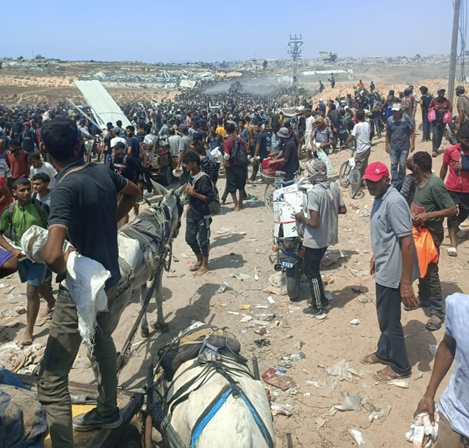
Eight months ago, there was an American aid station we called the ‘death trap’. Every day, more than 10,000 people ran toward it under gunfire. The journey began more than ten kilometers away. When the green flag appeared, we ran. Every day, more than ten people were killed and dozens were wounded. Still, we ran. We ran because we wanted to feed our children. Hunger became more terrifying than death. We reached for bread even when it was stained with blood.
When that aid ended, food began arriving through other crossings. Trucks pushed forward under gunfire, surrounded by desperate crowds. Thousands climbed onto them. Drivers wouldn’t stop, even when people fell beneath the wheels. Death became routine—by bullets or by tires. And all of it was for food.
These memories do not leave me.
My daughter Layla is five years old. Because of this war—because of the bombings and the constant fear—she suffers from cognitive impairment and loss of speech. This is what war does to children. This is the invisible wound that will remain long after the bombs stop.
Life in Gaza is woven from fear and endurance, from hunger and fragile hope. Every empty plate, every child’s thirst, every mother’s cry is part of our story.
And yet, despite everything, we are still here.
We still dream.
We still hope.
We still survive.
This is Gaza.
And this is our voice.
This article was written by a member of the Gaza Support Network, living in Gaza and struggling to survive under inhumane conditions.
The Gaza Support Network is a community of people from Israel and around the world who refuse to look away. Through direct, monthly support, small groups of donors stand with families in Gaza—helping them secure food, medicine, and dignity. Together, we raise about $1,000 a month per family, send directly to them.
This is not politics.
This is not charity.
This is human beings choosing to care for one another.
Learn more:
https://www.gazasupportnet.com/english
Stand with a family in Gaza:
https://docs.google.com/forms/d/e/1FAIpQLSfhUt1UfLPggPDS3IRt9VFu6YYVFLKzkbLtw7LNtIYeSZeH0Q/viewform
*You can read this article also in Greek (translated by Lale Alatli).
 Η ΚΟΚΚΙΝΗ
[…] *Μπορείτε να διαβάσετε το κείμενο και στα αγγλικά σε αυτόν τον σύνδεσμο. […]
Μου αρέσει!Μου αρέσει!
[…] *You can also read «This is Gaza. This is our voice» by Ahmad Abu Omar at this link. […]
Μου αρέσει!Μου αρέσει!